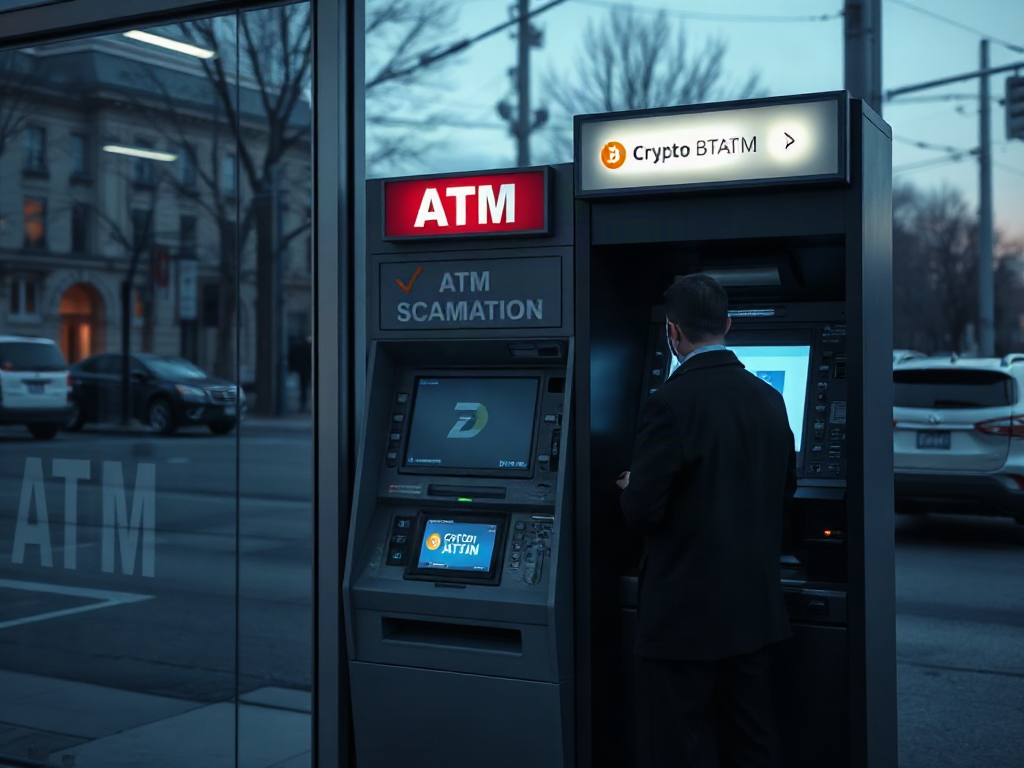
Crypto ATM scams and bitcoin investor warning signs are easiest to identify before payment by checking who initiated the contact, why cash or cryptocurrency is demanded, and whether the recipient is creating urgency or secrecy. A legitimate company or government agency will not direct someone to deposit cash into a crypto kiosk to settle taxes, protect an account, reverse fraud, or avoid arrest. Treat QR codes supplied by strangers, instructions to mislabel a transaction, and promises of guaranteed returns as stop signals. If money has already been sent, preserve the wallet address and receipt, notify the ATM operator immediately, contact the cash provider or bank, and report the incident to law enforcement and consumer-protection agencies.
How Crypto ATM Scams Turn Cash Into Irreversible Transfers
A crypto ATM is a payment channel, not a protective financial intermediary. Depending on the machine and operator, a customer may insert cash, select a cryptocurrency, and send the purchased assets to a wallet address. Scammers exploit that process because a completed blockchain transfer generally cannot be canceled merely by disputing it with the kiosk operator. The ATM may sell the cryptocurrency, but it does not verify that the person controlling the destination wallet is honest.
The scheme commonly begins somewhere other than the machine. A caller may impersonate a government office, bank fraud department, utility provider, technical-support desk, employer, or relative. A fake investment contact may cultivate trust through messages before claiming that a deposit must be made immediately. The target is then given a nearby kiosk location and a QR code representing a wallet address controlled by the scammer. Scanning that code can fill in the destination without requiring the victim to type or understand it.
Consider a person who receives a security alert and calls the number displayed in it. The supposed fraud agent says the person’s savings are exposed and must be converted to bitcoin in a “secure wallet.” The agent stays on the phone while the person withdraws cash and visits an ATM. Although the story is about protecting a bank account, the actual transaction sends newly purchased cryptocurrency to an unrelated wallet. Staying on the call discourages the target from pausing, consulting family, or reading the kiosk’s fraud warning carefully.
Legitimate personal use looks different. A customer decides independently to buy bitcoin, researches the operator’s fees and limits, and sends the purchase to a wallet whose ownership the customer can verify. Scam-directed use begins with an unsolicited problem or opportunity and ends at an address supplied by someone else. Even if the machine requests identification or displays warnings, those controls do not validate the recipient.
A weak assumption is that a transaction must be safe because a physical kiosk is located inside a familiar store. The retailer may only host the machine and may have no role in operating it or reviewing transfers. Before depositing cash, identify the ATM company from the machine itself, find its support details independently, and confirm who controls the receiving wallet. If another person selected the machine, supplied the QR code, or dictated what to say when prompted, stop the transaction.
Seven Warning Signs to Check Before Using a Kiosk
Scam pressure becomes easier to evaluate when the story is separated from the requested payment. A persuasive caller may know a name, address, employer, or partial account detail, but personal information is not proof of identity. Focus on whether the requested action makes sense for the organization the person claims to represent.
- Unsolicited direction to a crypto ATM: The contact chooses the payment method and often provides a specific kiosk location.
- Urgency or threats: The target is told that delay will cause arrest, account loss, service disconnection, penalties, or a missed profit.
- A supplied QR code: The code directs funds to a wallet the target does not independently control or recognize.
- Instructions to remain secret: The caller warns against speaking with relatives, bank employees, store staff, or police.
- A false reason for the payment: Cash-to-crypto deposits are presented as a way to safeguard money, cancel fraud, pay taxes, or verify an account.
- Coaching around safeguards: The contact tells the customer how to answer kiosk questions or dismiss fraud warnings.
- No ordinary exit: Requests to slow down, receive written documentation, or verify the claim through an official channel trigger more pressure.
The combination matters more than polished language. A genuine business may request timely payment, and an investor may voluntarily use a kiosk, but legitimate parties should permit independent verification. A demand that combines urgency, secrecy, and a stranger’s wallet address presents a fundamentally different risk. The safest response is not to negotiate for more time while standing at the machine; it is to leave without depositing cash.
Use a separate communication path to check the claim. If a caller says a bank account is compromised, hang up and call the number printed on the bank card or listed in the institution’s official app. If the caller claims to represent a government agency, locate the agency’s public contact information yourself. Do not call a number from the suspicious message, search advertisement, pop-up, or caller ID display, because those sources can be manipulated.
The same verification discipline applies to Crypto ATM scams and bitcoin investor warning signs involving friends or family. A message that appears to come from a known person may originate from an impersonated or compromised account. Call that person through a previously saved number and ask a question only they would reasonably know. A scammer’s irritation at verification is additional reason to disengage, not evidence that the emergency is real.
Investment Pitches That Lead Victims to Crypto ATMs
Investment-related ATM fraud often uses a longer trust-building process than an impersonation demand. The contact may begin through social media, a messaging application, a dating platform, or an unexpected text. Rather than demanding money immediately, the person discusses markets, displays supposed trading results, or directs the target to a website that appears to show a growing balance. Small early transactions may be presented as successful to make a larger deposit feel justified.
The displayed account balance is not reliable evidence that bitcoin was invested or that withdrawals are available. A fraudulent dashboard can show any return its operator chooses. The meaningful test is whether the investor controls the assets in a verifiable wallet or can withdraw funds without first sending additional money. Claims that a withdrawal requires advance taxes, unlocking fees, liquidity deposits, or account upgrades are strong warning signs, particularly when every payment must go to a new wallet address.
For example, an online contact might recommend a “private trading program” and instruct an investor to feed cash into a local kiosk. The investor scans the contact’s QR code and later sees a larger balance on a trading page. When withdrawal is requested, the platform demands another deposit to satisfy compliance requirements. The kiosk receipt proves only that cryptocurrency was purchased and transmitted; it does not prove that the trading account contains real assets or that the platform has a legitimate withdrawal process.
Normal investment risk and fraud risk should not be confused. Bitcoin’s market price can rise or fall sharply even when it is purchased through a legitimate service. Fraud risk concerns deception about custody, identity, access, or the existence of the investment itself. A claim of guaranteed returns, unusually smooth gains, risk-free arbitrage, or exclusive access removes the uncertainty that real market exposure necessarily carries. Screenshots, testimonials, and group-chat praise can all be fabricated or coordinated.
Before sending money, verify the company’s legal identity, physical contact details, withdrawal terms, and any registration claims through the relevant regulator’s own website. Search for the exact web domain rather than relying on a company name, because look-alike sites can imitate real firms. Do not install remote-access software or share a wallet recovery phrase with someone offering setup assistance. A recovery phrase gives control over the wallet; no legitimate adviser needs it to explain an investment.
Readers comparing Crypto ATM scams and bitcoin investor warning signs should prioritize custody over promotional returns. If the recipient controls the address and the investor cannot independently move the assets, the investor is relying on that recipient’s honesty. A lower fee, professional-looking dashboard, or friendly relationship does not repair that custody problem.
What to Do Before and After a Suspicious Payment
A pause before cash enters the machine offers far more protection than recovery efforts after transmission. Leave the kiosk, end the call, and preserve the message or QR code without scanning it again. Contact the supposed organization through an independently obtained number and describe the exact payment instruction. If the story involves a relative, reach that person or another trusted family member through an established channel.
Check the destination as carefully as the sender. A wallet address is a transfer instruction, not a verified identity. Ask who created it, who holds the private keys, and how ownership was confirmed. Someone who says the wallet is “yours” while refusing to let you access it independently is describing custody they control. Creating a personal wallet does not make every transaction advisable, but it prevents a stranger from disguising their address as a protective account.
If funds have already been sent, speed may improve the chance that an operator or investigator can trace the event, although recovery is not assured. Use the support number displayed on the operator’s official website or transaction receipt, not a number supplied by the suspected scammer. Give the operator the transaction time, kiosk location, amount, receipt identifier, destination address, and transaction hash if available. Ask what fraud-review process applies and keep a record of the response.
Preserve evidence before blocking contacts or deleting applications. Useful material may include:
- ATM receipts, bank withdrawal records, and photographs of the kiosk;
- wallet addresses, QR codes, transaction hashes, and website domains;
- phone numbers, usernames, email addresses, messages, and call times;
- instructions given by the contact, including requests for secrecy or additional fees.
Report the event to local law enforcement and the appropriate national fraud-reporting or consumer-protection service. In the United States, possible reporting channels include the Federal Trade Commission’s fraud portal and the FBI’s Internet Crime Complaint Center. A bank or cash provider should also be notified if a withdrawal, transfer, or account compromise formed part of the scheme. Reports may support pattern detection even when an individual transfer cannot be reversed.
Beware of a second loss through recovery fraud. People who claim they can retrieve cryptocurrency for an upfront payment, “gas fee,” private key, or recovery phrase may be targeting known victims. Blockchain tracing can help qualified investigators follow transactions, but tracing an address is not the same as obtaining legal control of funds. Do not pay an unsolicited recovery agent or give remote access to a phone or computer.
A practical sign that the response is working is that all further payments have stopped, accounts and devices are secured, evidence is preserved, and reports contain complete transaction details. A failing response usually involves continued communication with the scammer, another payment to release the first one, or reliance on a person promising guaranteed recovery. Reviewing Crypto ATM scams and bitcoin investor warning signs with a trusted person can expose contradictions that urgency made difficult to see.
Frequently Asked Questions
Can a crypto ATM transaction be reversed?
A completed cryptocurrency transfer generally cannot be canceled like a card payment. Contact the ATM operator immediately because its fraud procedures and ability to respond depend on the transaction’s status and circumstances.
Will a government agency ask for payment through a bitcoin ATM?
Treat any such request as fraudulent. End the contact and verify the claim using contact information published on the agency’s official website rather than a number supplied by the caller.
Does a kiosk fraud warning mean every crypto ATM purchase is a scam?
No. The warning highlights common scam conditions. The decisive questions are who initiated the purchase, who controls the destination wallet, and whether pressure or deception is shaping the transaction.
What information should be saved after an ATM scam?
Keep the receipt, kiosk location, date and time, amount, wallet address, transaction hash, QR code, messages, phone numbers, usernames, and any bank withdrawal record.
Can a company guarantee recovery of stolen bitcoin?
No credible party can guarantee recovery. Be wary of unsolicited recovery offers requiring advance payments, wallet credentials, a recovery phrase, or remote access to a device.
Conclusion
The decision point arrives before the QR code is scanned and the cash is accepted. Identify who initiated the transaction, verify the claimed organization through a separate channel, and establish who controls the receiving wallet. Urgency, secrecy, coaching around kiosk warnings, guaranteed returns, and extra fees to unlock withdrawals should end the transaction rather than accelerate it.
After a suspected loss, stop sending money and document every transfer detail. Contact the ATM operator, secure affected financial and online accounts, and file reports with appropriate law-enforcement and consumer-protection channels. Recovery may be difficult, so reject anyone who promises certainty in exchange for another payment or wallet credentials. A short delay for independent verification costs little; completing a stranger-directed blockchain transfer can create consequences that are much harder to undo.